

Welcome to Marketing By One, the weekly newsletter for time-starved, budget-conscious solo entrepreneurs, creators, and marketers.
Let’s talk free vs. paid. Take the weekly challenge. Get an end-of-the-year marketing tip. Catch up on the marketing news!
— Ann Gynn
The Hotline
Should You Switch From Free to Paid?
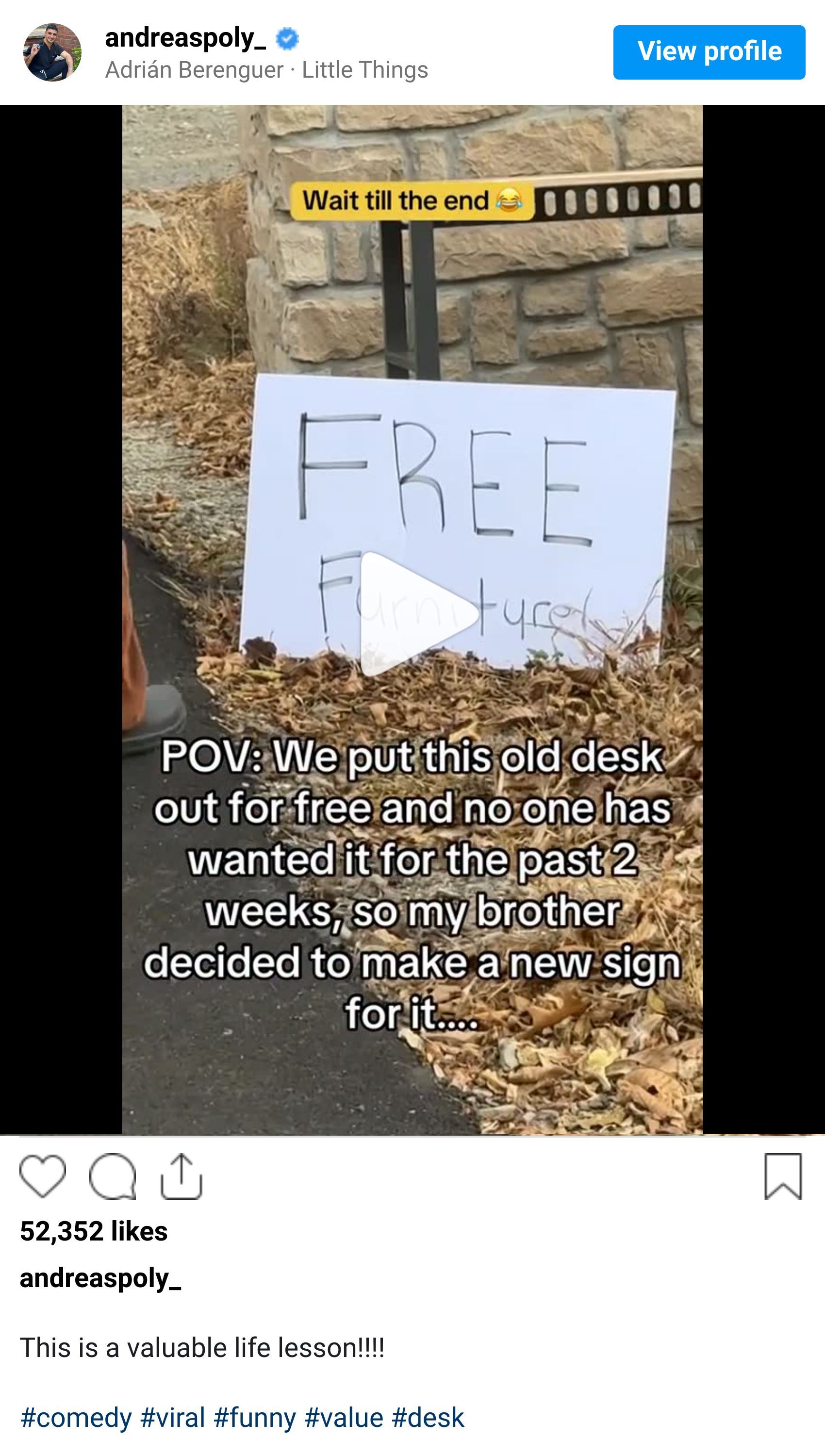
I saw this reel on Instagram. A family left a desk in their yard with a “free” sign. No one picked it up for two weeks. So, they put up a new sign, “Desk $50,” and someone “stole” it within a few hours.
Sure, it may be a skit, but it’s based on reality, and it got me thinking, not about stealing, but about good marketing. When people see “free,” they perceive it as less valuable. When they see a dollar sign (or other currency symbol), they think it’s more valuable.
Years ago, I posted an opportunity for freelance writers and asked for their hourly rates. Someone replied with $0, and a few quoted $5 an hour. I didn’t consider them viable candidates. Those lowball (or is it freeball?) rates indicated they wouldn’t deliver what I needed, that their work would require more editing and coaching to achieve a usable product.
Yet, free is a trap that many solo entrepreneurs and creators fall into
. (And yes, I do see the irony that I am saying this in a free newsletter.)
In this 2025 Harvard Business Review article, Saloni Firasta-Vastani explains the consumer psychology and behavioral economics research: “(F)ree offerings are frequently undervalued, overused, or abused. They create expectations that are hard to unwind and threaten long-term sustainability.”
People can also succumb to the sunk cost fallacy: since they paid for it, they should use it (or do it). Research from Just Attend, an event management platform, found that paid event attendance averaged 87%, compared with 60% to 65% for free events.
Alternatives to ‘free’ products or services
So, how do you use “free” as a marketing strategy? You don’t promote it that way.
Make it an “added value” or “bonus” packaged with a paid product. It meets people’s need to get something for free and your need to demonstrate the brand’s value. Put a dollar (or other currency) amount on the bonus offering to give perspective on its value.
Ask for something in exchange for the free offering. It could be an email address, a referral, or a social share. Just make sure to craft the promotion so the audience can easily see they’re giving you something and you’re giving them something.
Set a low, low price. People who are genuinely interested in the offering likely won’t hesitate to pay a few bucks for something they find valuable. If they balk at the low, low price, they probably weren’t your target audience anyway.
What do you think? Do you have a free and/or paid strategy to market your business? Reply to this email or text me at +1.216.235.4566.
The Challenge
Identify a bonus to bundle with a product or service you sell. Describe its benefits and put a dollar value on it. Just make sure all the details are plausible. After all, you don’t want to say a value-added coaching session is worth $10,000; your prospective buyers won’t believe it (or anything else you have to say or sell).
The Marketing Minute
Make it a 10
Put together a perfect end-of-the-year social media post, video, or blog article. It could be a holiday gift list of 10 things to buy (including your product or service). Publish the top 10 content hits from your 2025 content. Or list 10 things to do before 2025 ends. Just make sure any list of 10 relates to your business and your audience.
The Shortlist
Loosen perfection’s grip. Bryan Kramer of the BEing Human newsletter didn’t deliver his edition on Tuesday. It led to a great intro in the newsletter on Wednesday that all of us should consider: “I had to let the idea of perfection loosen its grip on my collar. So today I’m allowing myself to be late. That might be the whole point anyway. Show up. Tell the truth. Keep going.”
Think clients. Punctuation’s David C. Baker gets into why clients come, stay, and leave. (Hat tip to Josh Spector for sharing it.)
Appealing visuals. Good news for entrepreneurs who prefer creating words over visuals. Google launched Nano Banana Pro. It visualizes ideas and designs anything from prototypes to infographics. It’s packaged into Google Ads and Google Workspace.
Join Us
Not a subscriber? Join the Marketing By One community today. Sign up for the free weekly newsletter!
Got a question you’d like me to answer in The Hotline? Email me or DM me on LinkedIn.